Am I doing it wrong?
A book that should have paid attention to years ago

I have been messed with. Chewed up, swallowed, and spit back out. I am not the same. Because I read a book. Not just any book, mind you. A book that I should have read much sooner in my PhD journey, even in my life as a student in general. I’m sure if I went through all of my college and Seminary syllabi, I could find the book on a recommended list. There is a high likelihood that some of my professors and mentors talked about this book as a great guide to the type of reading that is required to read, research, and write for an original contribution in the academy. However it was originally presented to me, I missed it. And I’m so darn mad that I did. What finally got me to consider this book a YouTube video: I did a PhD without knowing how to read.
The title worked. I was scared. As a self-proclaimed imposter, I was scared that I too was “doing it wrong.” LanguageJones reviews two books that he wishes that he would have been exposed to before or during his PhD journey. However, the true benefit of the video is not just his explanation of the books and a call to action: buy them and read them. It is also a detailed compare/contrast vlog on how he used to approach research and writing before reading these texts. This is not the first video that makes the case for this (and the other TBR book) book to move to the top of the reading list, but it was the first one that felt like it was in a situation that I could transfer to my own life (transfer, of course is the point of all our reading and thinking—we want to be able to understand and transfer is the best evidence to be declared guilty of understanding). So I bought the book. It arrived on 5/20/2026 and I finished it on 5/23/2026. Not the fastest for 336 pages, but a book where I could not wait to finish. I’ve kept you in suspense long enough - the book is How to Read a Book1 by Mortimer Adler.
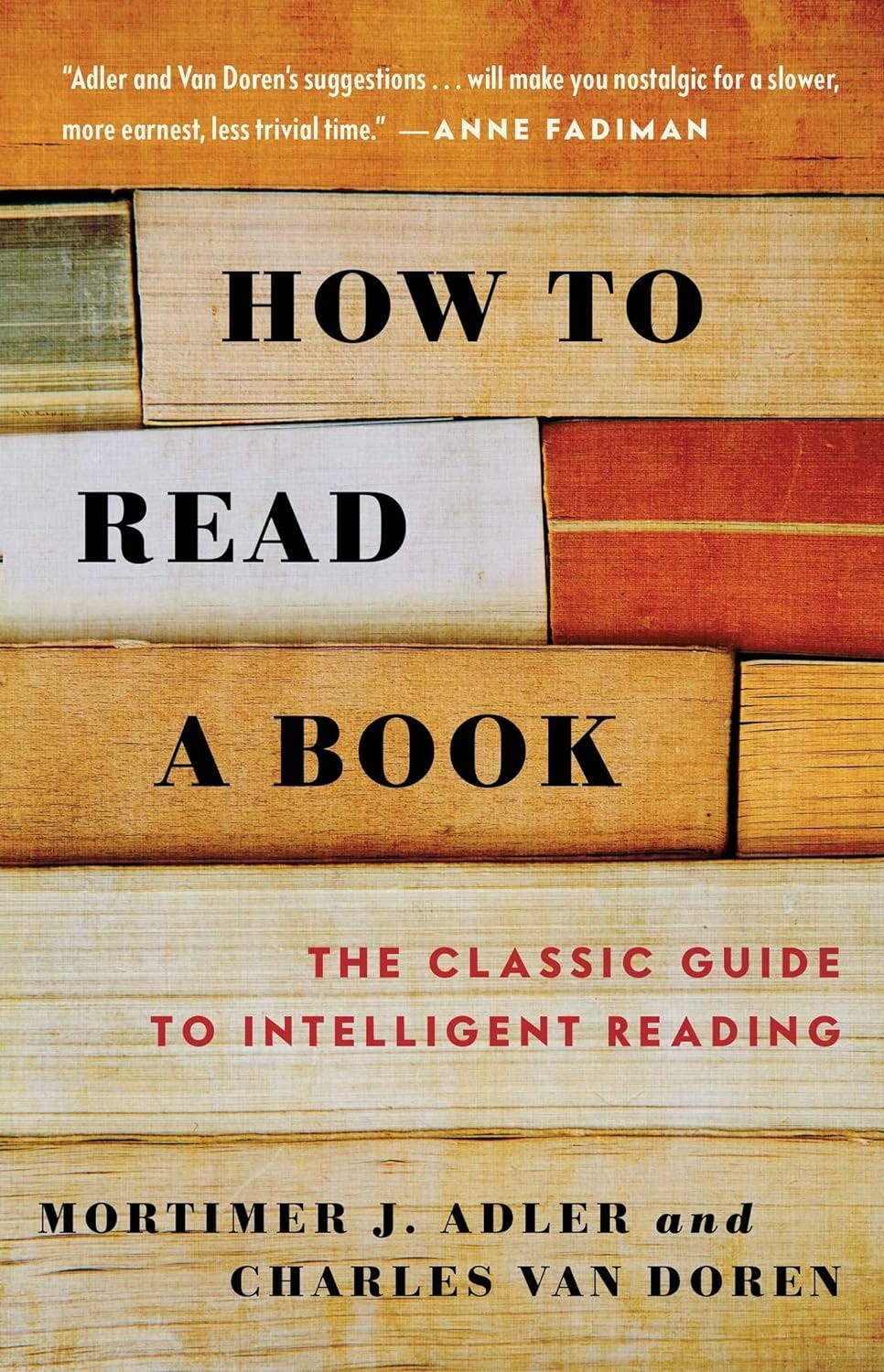
It almost sounds comical for someone who is working on a PhD to read a book on how to read a book. The irony is not lost on me that I am supposedly halfway through my marathon and only now really learning how to read, but we all have room to grow and another day to do some growing. The book was originally published in 1940, and updated 30 years later to account for some of the deficiencies and criticism. My favorite quip from Adler concerning the criticism is his own account of the responses that his book received after being published. How to Read 2 Books and How to Read a Page were two books that were published in response to this book (one serious and one a parody). He takes both of them in stride and just keeps on with is task - teaching me and encouraging me to become a demanding and active reader.
I started this Substack with the intentions of writing a digest article of every book that I had read in the marathon toward the comprehensive exam and eventual dissertation. I learned how to learn and take “Smart Notes” by doing a little more learning about note cards and spaced repetition. Once again, thanks YouTube. But I got scared. Scared to write the thesis section on my notecards, and scared to write the definitive article about the books I was reading. I wrote a couple, but they turned into journals about what I was thinking or feeling during the process of reading—not necessarily a proper outline or critical reaction to the book.
This needs to change.
Ryan Holiday taught me that my books are not precious and I need to mark them up to have a conversation with the author. Robert Greene taught me that the process of notecards would help the contents and arguments of books stick with me. Sönke Ahrens taught me how to make my notes smart and atomic, as well as the best way to classify them for learning and thinking. Mike Schmitz taught me how to link my thinking so the notes create and connect to have a life of their own with tags and links. Mortimer Adler taught me to read a book. At least, to read in the sort of way that I should have been during this process - as a demanding and active reader.
Here’s my attempt to think out the book on paper for myself and others. Mostly for myself, but maybe this will help the reader as well. I’m trying to get my thoughts onto “paper” along with an account of the learning as it came to happen.
Reading is hard and should be quite active. The way that we typically read for pleasure, relaxation, or information is not the same way that we should be reading for proper understanding. That type of reading demands our attention, participation, and clear thinking. Adler makes the case that how we read is just as important as what we read—although he’s got some thoughts and feelings on that, the Great Books of the Western World should be standard for any serious academic. In order to make his readers into better readers of all sorts of writing (not just practical books like his, a distinction that is essential in this task), he offers that there are 4 levels of reading: elementary, inspectional, analytical, and synoptical. Each higher level of reading contains the others before it in sort of a pyramid or spiral kind of way.
The First Level - Elementary Reading
Elementary reading is exactly what it sounds like. The level of reading that most of the world attains in elementary or primary school since basic literacy has become so widespread and accessible. A la Voelz, this is when we are able to decode level one signifiers (marks and scratches on pages that make letters and words). Since the 1970s, education has focused on literacy and what Johnny can or can’t do. What is the proper balance between phonics and sight words? That is what we have been consumed with concerning elementary reading. In this section, Adler makes the case that our hyper focus on making sure every student or child makes it to this level, has created an artificial glass ceiling (my term, not his; trying to follow his advice) for the other levels of reading. In a universal effort to make sure everyone makes it to this level, we have effectively ensured that very few make it beyond.
To reach the end of elementary reading, one is read enough to do high school work. They can read and make meaning along with authors. They can follow arguments and plot points. They can begin to deal with abstract concepts and thoughts. In a sense, he is prepared to learn more through reading. Apparently, there was quite the fad of speed reading when Adler wrote that he needed to address it in this section.
High School & College Reading Ends
Not associated with elementary reading, but in the chapter as an aside, Adler opines what a “good” high school and college education should provide. “A good liberal arts high school, if it does nothing else, ought to produce graduates who are competent analytical readers” and “a good college, if it does nothing else, ought to produce competent syntopical readers.”2 As an aside, Adler remarks that something is quite wrong if it takes twenty full years of schooling to become a reader on all four levels. I think I am quite wrong and need some fixing.
The next three levels of reading are all associated with rules and steps. Below is my attempt to write them all out as a summary of the book as well as for my own reference in the future. Like I said at the beginning, this book messed with me—I’ve already been trying to incorporate its principles in my reading and writing. If you’ve read the book, I hope this article is filled with easter eggs of application. If you haven't, just know that I’m also trying to walk the walk.
The Second Level - Inspectional Reading
Look at the Title Page and, if the book has one, its Preface
Study the Table of Contents (write some ideas on the page for what the book is about)
Check the Index
Read the Publisher’s Blurb, if it has one
Look at the chapters that seem to be pivotal to its argument
Turn the pages, dipping in here and there, reading a paragraph or two, sometimes several pages in sequence, never more than that. (I did this for this book at this point in the reading)
The 3rd Level - Analytical Reading
We have finally arrived at the level of reading that I think most of us are familiar with, at least in style and intention. This is how I originally thought of this level: Grab the book and read so that you can understand and communicate or apply the fruits of the author’s labor. Go from foreward to afterward and then grab another. Maybe you’ll return to the book in the future, but the work as been accomplished as long as each page has been looked at and the words have passed by your eyeballs. Perhaps you’ll fall asleep during your reading because the whole point is just for the author’s monologue to appear in your brain like the opening credit crawl from Star Wars. Not for Adler, and hopefully no longer for me. In order to properly read analytically, some preparation is needed. Not just in previous levels, but also in the later level (Adler makes this make sense at the end of the book, even if it didn’t for me in the moment, and probably doesn’t for you right now either).
The Essence of Active Reading: Four Basic Questions a Reader Asks
What is the Book about as a whole?
What is being said in detail, and how?
Is the book true, in whole or part?
What of it?
These four questions get teased out into 15 basic rules of analytical reading that Adler demonstrates in part 2 of the book. They are grouped into a first, seconds and third stage. The third stage is an extended treatment of being a proper and fair critic of the books you read. For reading, note taking, and moving toward more understanding through reading, the first 8 steps get the reader quite far into the process.
The First Stage of Analytical Reading
Classify the book according to kind and subject matter
State what the whole book is about with utmost brevity
Enumerate its major parts in their order and relation, and outline these parts as you have outlined the whole
Define the problem or problems the author is trying to solve.
The Second Stage of Analytical Reading
Come to terms with the author by interpreting his key words.
Grasp the author’s leading propositions by dealing with his most important sentences
Know the author’s arguments, by finding them in, or constructing them out of, sequences of sentences.
Determine which of his problems the author has solved, and which he has not; and as to the latter, decide which the author knew he had failed to solve.
The Third Stage of Analytical Reading
A. General Maxims of Intellectual Etiquette
Do not begin criticism until you have completed your outline and your interpretation of the book. (Do not say you agree, disagree, or suspend judgment, until you can say “I understand.”)
Do not disagree disputatiously or contentiously
Demonstrate that you recognize the difference between knowledge and are personal opinion by presenting good reason for any critical judgment you make
B. Special Criteria for Points of Criticism
Show wherein the author is uniformed.
Show wherein the author is misinformed.
Show wherein the author is illogical.
Show wherein the author’s analysis or account is incomplete.
Syntopical Reading
Requirements:
Know that more than one book is relevant to a particular question
Knowing which books should be read, in a general way
The unfortunate thing for syntopical reading is that it is indicative reading. The identification of your subject matter (say, for a PhD dissertation or research) must follow the reading, not precede it. You might be halfway through a reading marathon and realize that a lot of the pages you have read have not addressed your questions and subject matter at all. That sounds quite frustrating, but you would not have known that they didn’t fit without being exposed to them. You have been brought to a further understanding of what doesn’t fit.
The sentence that broke me
“The first thing to do when you have amassed your bibliography is to inspect all of the books on your life. You should not read any of them analytically before inspecting all of them.”3 WHAT?! is all that I have written in the margin. I’ve been doing this wrong. I’ve been reading and annotating my books and letting some general inspiration lead me to other books in the lists or as I build my own. I had a general sense that I should read roughly in publication order, but I did not have the sense to inspect all my books before beginning the journey. I thought that infect my reading like seeing a spoiler for a movie I’m really excited about. Nope, turns out it would have helped me bring the Ring to Mordor if I knew where I was going.
Eventually, the proper syntopical reader is choosing books that relate to the problems that he is interested in and incorporating them in the reading plan. But he is not able to do this until a number of books have been read and inspected first. It is a catch 22, but it does require a starting point. If I would have read Browning’s Practical Theology after reading this book, I would have annotated it differently. If I would have read Taylor’s A Secular Age after Adler, I would not have picked up Smith’s How (Not) to be Secular since Adler recommends that we need to reckon with an author before seeking outside aids. I picked up some lighter dumbbells for the end of that book, and it will probably show in my future treatments and analysis of it.
Syntopical reading is taking all of your books, thinking, notes, ideas, and applications and forcing them into a natural conversation. It’s letting Osmer, Kant, Luther, Adler, Dewey, Browning, Kolbd, Taylor, Niebuhr, Ahrens, and Korcok have a pretend (yet very real) and playful conversation that I facilitate through inquiry and connection. A conversation that might not come to fruition until yet others are brought to terms that I have set for the discussion. This process is iterative and recursive. I probably won’t finish with this even after the final draft of the dissertation has been submitted. Because what syntopical reading is about is understanding and learning.
Thank you for reading this far, I really appreciate it. If this article has helped you become a better reader or inspired to read some more books, I’ll take the win. Below is an incomplete list of things that I know I missed in my treatment of the book. They may serve as articles in the future.
Missing Items in this Article
The Great Books of the Western World as Illustrations
How to read certain types of books
A guided account of the Inspectional Reading process
The Recommended Reading List
The Appendices and Exercises to grow as a reader
Extensive treatment of notes and annotations (I still need to digest and write them out, this was just a basic “Inspectional” analysis)
Adler, Mortimer Jerome, and Charles Van Doren. How to Read a Book. Rev. and Updated ed. Simon and Schuster, 1972.
ibid. 28-29. Emphasis mine.
ibid. 306.
So hey, you're becoming an expert on the act of reading itself which is, you know, my thing. And you're doing it better. :-) WHAT AN ENCOURAGING POST!